Photographer Curt Fonger captured some great images of a bobcat that climbed a cactus. The photographer says the bobcat climbed the saguaro to escape a mountain lion.
"When he looked down at me, those beautiful amber eyes with those dark slits said it all. It was so refreshing to be able to personally witness this bobcat at that precise moment," Fonger said. "A story of survival. He wasn't nervous or frightened. Instead he had a personified "Calm after the Storm" demeanor. A lesson more of us could learn from."
Elijah Wood as Frodo in Peter Jackson's live-action version of The Lord of the Rings.Image via Wikipedia
Deadline.com hinted first but TheOneRing.net has confirmed thatElijah Woodwill appear inThe HobbitasFrodo Baggins. According to TheOneRing.net, "As readers of 'The Hobbit' know, the tale of 'The Downfall of The Lord of the Rings' and 'The Hobbit or There and Back Again,' are contained in the fictional 'Red Book of Westmarch.' In Peter Jackson’s LOTR films, the book is shown on screen and written in by Bilbo and Frodo and handed off to Sam Gamgee. (Not explained on film are Sam’s progeny later having the book and being Wardens of the Westmarch — hence the book’s title.) The fictional book, and either the telling from it or the reading of it, will establish Frodo in the films experiencing Bilbo’s story. Viewers are to learn the tale of ‘The Hobbit’ as a familiar Frodo gets the tale as well."
Ted Williams (born 1957) is a voiceover artist from Columbus, Ohio who became famous when a brief interview with him while he was homeless was posted to YouTube, quickly becoming a viral video sensation. He has been called the "Homeless Man with the Golden Voice".
Last week, Pantone (the global authority on color and provider of professional color standards for the design industries) announcedHoneysuckle, a vibrant, energetic hue, as the color of the year for 2011.
While the 2010 color of the year, PANTONE 15-5519 Turquoise, served as an escape for many, Honeysuckle emboldens us to face everyday troubles with verve and vigor. A dynamic reddish pink, Honeysuckle is encouraging and uplifting. It elevates our psyche beyond escape, instilling the confidence, courage and spirit to meet the exhaustive challenges that have become part of everyday life.
"Whether envisioned as a tranquil ocean surrounding a tropical island or a protective stone warding off evil spirits, Turquoise is a color that most people respond to positively. It is universally flattering, has appeal for men and women, and translates easily to fashion and interiors. With both warm and cool undertones, Turquoise pairs nicely with any other color in the spectrum. Turquoise adds a splash of excitement to neutrals and browns, complements reds and pinks, creates a classic maritime look with deep blues, livens up all other greens, and is especially trend-setting with yellow-greens."
Turquoise is a slightly greenish tone of cyan (from Greek: κύανoς (transliterated: kýanos), meaning "blue") . The color is based on the gem turquoise. The term comes from the French for Turkish.
The turquoise gemstone is the namesake for the color. In many cultures of the Old and New Worlds, this gemstone has been esteemed for thousands of years as a holy stone, a bringer of good fortune or a talisman. The oldest evidence for this claim was found in Ancient Egypt, where grave furnishings with turquoise inlay were discovered, dating from approximately 3000 BC. In the ancient Persian Empire, the sky-blue gemstones were earlier worn round the neck or wrist as protection against unnatural death. If they changed color, the wearer was thought to have reason to fear the approach of doom. Meanwhile, it has been discovered that turquoise certainly can change color, but that this is not necessarily a sign of impending danger. The change can be caused by light, or by a chemical reaction brought about by cosmetics, dust or the acidity of the skin.
Anna Chapman, the almost stereotypical "Bond girl”, accused of spying for the Russian government appeared on Russian talk show “Пусть говорят” (Let Them Talk). The 60 minutes episode “Let them talk. New Year with a girl of the year” was dedicated to Anna Chapman and featured her mother, sister, grandmother, school teachers, friends and her first love.
Watch online "Let them talk. New Year with a girl of the year"
Anna Chapman full video (1 hour, Russian language)
The Voyage of the Dawn Treader held its world premiere on November 30, 2010 in London at the Royal Film Performance* in Leicester Square. It was the first time the Royal Film Performance was screened in Digital 3-D and the second time a Narnia film premiered at the event, the first being The Lion, the Witch, and the Wardrobe in 2005. The premiere was attended by various personalities, including Queen Elizabeth II and Prince Philip.
*The Royal Film Performance is a charity performance of a British film which is attended by members of the British Royal Family. The proceeds from the evening's entertainment are donated to the Cinema and Television Benevolent Fund, a charity which offers financial support to people from the film, cinema and television who encounter accident, illness, bereavement or unemployment.
The tradition was started with A Matter of Life and Death in 1946 and has continued every year since then.
The Royal World Premiere of The Chronicles of Narnia: The Voyage of the Dawn Treader held at The Odeon Leicester Square on November 30, 2010 in London, United Kingdom
Set a year after the events of the previous film, the two youngest Pevensies Edmund (Skandar Keynes) and Lucy (Georgie Henley) are transported back to Narnia along with their cousin Eustace Scrubb (Will Poulter). They join the new king of Narnia, Caspian (Ben Barnes) in his quest to rescue seven lost lords to save Narnia from a corrupting evil that resides on a dark island. Each character is tested as they journey to the home of the great lion Aslan at the far end of the world.
The film premiered on November 30, 2010, at a Royal Film Performance in London. It had a wide theatrical release in traditional 2D, RealD 3D, and Digital 3D, and a limited release in 4D worldwide on December 10.
Award nominations
On 14 December 2010, the song "There's a Place for Us" from the film was nominated for a Golden Globe Award for Best Original Song at the 68th Golden Globe Awards. It also received 3 nominations in Best Youth Actor (Will Poulter), Best Live Action Family Film and Best Original Song at Phoenix Film Critics Society Awards.
Plot Begun in January, completed in February 1950 and published on 15 September 1952, The Voyage of the ‘Dawn Treader’ returns Edmund and Lucy Pevensie, along with their priggish cousin, Eustace Scrubb, to Narnia. Once there, they join Caspian's voyage on the ship Dawn Treader to find the seven lords who were banished when Miraz took over the throne. This perilous journey brings them face to face with many wonders and dangers as they sail toward Aslan's country at the end of the world.
Influences
Arguably, Voyage of the Dawn Treader is the novel which shows the most influence from Lewis' Irish background. It is reminiscent of the Immram genre of Irish literature. However, unlike such voyages, The Dawn Treader travels East, rather than West.
It was suggested that that the Odyssey was an inspiration for it as well. It might also symbolize Paul's journey in the Bible.
The Chronicles of Narnia: Prince Caspian,
illustrated by Pauline Baynes
Image via books online store
Prince Caspian: The Return to Narnia is a novel for children by C. S. Lewis, written in late 1949 and first published in 1951. It is the second book in the Chronicles of Narnia series, although in the overall chronological sequence it comes fourth.
Themes
The two major themes of the story are courage and chivalry and, as Lewis himself said in a letter to an American girl, "the restoration of the true religion after a corruption".
Adaptations
The BBC adapted Prince Caspian in two episodes of the 1989 series of The Chronicles of Narnia.
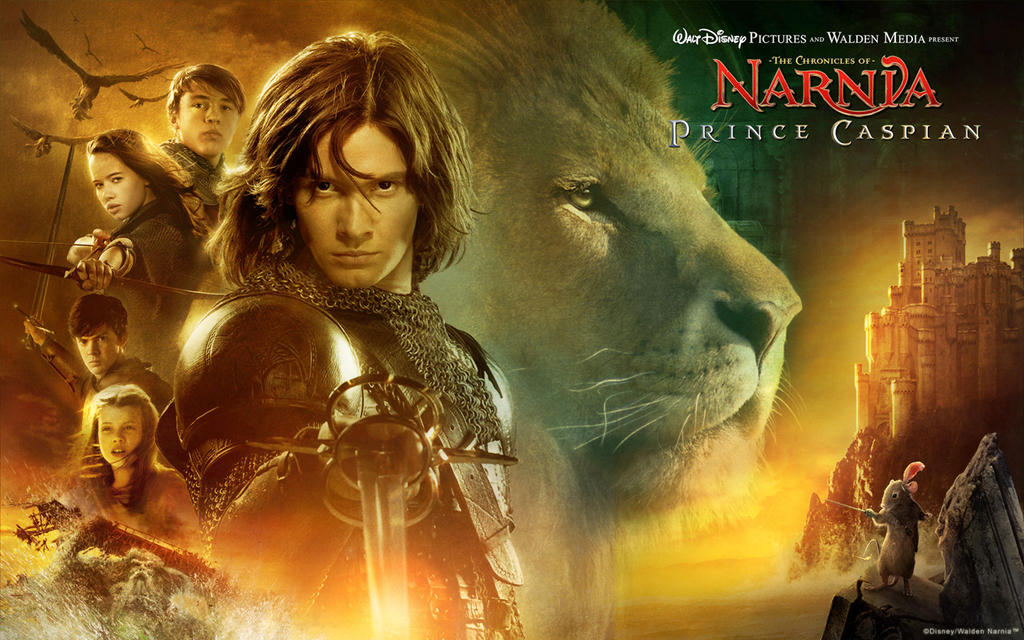
The second in the series of films from Walden Media, titled The Chronicles of Narnia: Prince Caspian, was released in the US on 16 May 2008. The UK release date was 26 June 2008.
The Chronicles of Narnia: The Lion, the Witch and the Wardrobe is a 2005 epic fantasy adventure film directed by Andrew Adamson and based on The Lion, the Witch and the Wardrobe, the first published and second chronological novel in C. S. Lewis's children's epic fantasy series, The Chronicles of Narnia. It was co-produced by Walden Media and Walt Disney Pictures and distributed by Walt Disney Pictures. William Moseley, Anna Popplewell, Georgie Henley and Skandar Keynes play Peter, Susan, Lucy and Edmund, four British children evacuated during the Blitz to the countryside, who find a wardrobe that leads to the fantasy world of Narnia. There they ally with the Lion Aslan (voiced by Liam Neeson) against the forces of Jadis, the White Witch (Tilda Swinton).
The film was released on December 9, 2005 in both Europe and North America to positive reviews and was highly successful at the box office. It won the 2005 Academy Award for Best Make Up and various other awards and is the first film in the series of films based on the books. An Extended Edition was released on December 12, 2006 and was only made available on DVD until January 31, 2007 when it was discontinued. It was the best selling DVD in North America in 2006 taking in $332.7 million that year. Source: wiki
The Lion, the Witch and the Wardrobe cover. Image: photobucket
The Lion, the Witch and the Wardrobe is a fantasy novel for children by C. S. Lewis. Published in 1950 and set circa 1940, it is the first-published book of The Chronicles of Narnia and is the best known book of the series. Although it was written and published first, it is second in the series' internal chronological order, after The Magician's Nephew. Time magazine included the novel in its TIME 100 Best English-language Novels from 1923 to 2005. It has also been published in 47 foreign languages.
Lewis dedicated the book to his god-daughter, Lucy Barfield.
Writing
Lewis described the origin of The Lion, the Witch and the Wardrobe in an essay entitled It All Began with a Picture:
"The Lion all began with a picture of a Faun carrying an umbrella and parcels in a snowy wood. This picture had been in my mind since I was about sixteen. Then one day, when I was about forty, I said to myself: 'Let's try to make a story about it.'"
The Lion, the Witch and the Wardrobe. Faun carrying an umbrella and parcels. Image: photobucket
Shortly before World War II, many children were evacuated from London to the English countryside to escape attacks on London by Nazi Germany. On 2 September 1939 three school girls: Margaret, Mary and Katherine, came to live at The Kilns in Risinghurst, Lewis's home three miles east of Oxford city centre. Lewis later suggested that the experience gave him a new appreciation of children and in late September he began a children's story on an odd sheet which has survived as part of another manuscript:
"This book is about four children whose names were Ann, Martin, Rose and Peter. But it is most about Peter who was the youngest. They all had to go away from London suddenly because of Air Raids, and because Father, who was in the Army, had gone off to the War and Mother was doing some kind of war work. They were sent to stay with a kind of relation of Mother's who was a very old professor who lived all by himself in the country."
How much more of the story Lewis then wrote is uncertain. Roger Lancelyn Green thinks that he might even have completed it. In September 1947 C.S. Lewis wrote in a letter about stories for children: "I have tried one myself but it was, by the unanimous verdict of my friends, so bad that I destroyed it."
In August 1948, during the visit of the American writer Chad Walsh, Lewis vaguely talked about completing a children's book which he had begun "in the tradition of E. Nesbit". After this conversation not much happened - until the beginning of the next year. Then everything changed.
In his essay It All Began With a Picture C.S. Lewis continues: "At first I had very little idea how the story would go. But then suddenly Aslan came bounding into it. I think I had been having a good many dreams of lions about that time. Apart from that, I don't know where the Lion came from or why He came. But once He was there, He pulled the whole story together, and soon He pulled the six other Narnian stories in after Him."
On 10 March 1949 Roger Lancelyn Green dined with him at Magdalen College. After the meal, Lewis read two chapters from his new children's story to Green. Lewis asked Green's opinion of the tale, and Green thought it was good. The manuscript of The Lion, the Witch and the Wardrobe was complete by the end of March 1949. Lucy Barfield received it by the end of May. When on 16 October 1950 Geoffrey Bles in London published the first edition, three new Chronicles - Prince Kaspian, The Voyage of the Dawn Threader and The Horse and His Boy - had also been completed.
The Chronicles of Narnia (film series) Image by spunkynell
The Chronicles of Narnia is a series of epicfantasy films from Walden Media based on the series of novels, The Chronicles of Narnia written by C. S. Lewis in the 1950s. It currently consists of three films of a planned heptalogy - The Lion, the Witch and the Wardrobe (2005), Prince Caspian (2008), and The Voyage of the Dawn Treader (2010).
Although Lewis did not want his books to be turned into films, it has been done four times, three of them for television. The BBC made television serial adaptations of The Lion, the Witch and the Wardrobe, Prince Caspian, The Voyage of the Dawn Treader and The Silver Chair. A film version of The Lion, the Witch and the Wardrobe, entitled The Chronicles of Narnia: The Lion, the Witch and the Wardrobe, produced by Walden Media and distributed by Walt Disney Pictures was released in December 2005. Permission for films to be made was given by C. S. Lewis' stepson, Douglas Gresham. It was directed by Andrew Adamson. The screenplay was written by Ann Peacock. Principal photography for the film took place in Poland, the Czech Republic and New Zealand. Source: wiki
The Chronicles of Narnia is a series of seven fantasynovels for children written by C. S. Lewis. It is considered a classic of children's literature and is the author's best-known work, having sold over 100 million copies in 47 languages. Written by Lewis between 1949 and 1954, illustrated by Pauline Baynes and published in London between October 1950 and March 1956, The Chronicles of Narnia has been adapted several times, complete or in part, for radio, television, stage, and cinema. In addition to numerous traditional Christian themes, the series borrows characters and ideas from Greek and Roman mythology, as well as from traditional British and Irishfairytales.
The Chronicles of Narnia presents the adventures of children who play central roles in the unfolding history of the fictional realm of Narnia, a place where animals talk, magic is common, and good battles evil.
The series
Lewis originally conceived what would become Narnia in 1939. However the vast majority of the text was written by between 1949 and 1954. The books were written in neither the order they were originally published nor in the chronological order in which they are currently presented.
Lewis was awarded the 1956 Carnegie Medal for The Last Battle, the final book in the Narnia series.
The seven books that make up The Chronicles of Narnia are presented here in the order in which they were originally published:
The Lion, the Witch and the Wardrobe (1950)
Prince Caspian: The Return to Narnia (1951)
The Voyage of the Dawn Treader (1952)
The Silver Chair (1953)
The Horse and His Boy (1954)
The Magician's Nephew (1955)
The Last Battle (1956)
"Rapunzel" is a Germanfairy tale in the collection assembled by the Brothers Grimm, and first published in 1812 as part of Children's and Household Tales. The Grimm Brothers' story is an adaptation of the fairy tale Persinette by Charlotte-Rose de Caumont de La Force originally published in 1698. Its plot has been used and parodied in various media and its best known line ("Rapunzel, Rapunzel, let down your hair") is an idiom of popular culture.
Name Origin
Campanula rapunculus, one candidate
It is difficult to be certain which plant species the Brothers Grimm meant by the word Rapunzel, but the following, listed in their own dictionary, are candidates.
Valerianella locusta, common names: Corn salad, mache, lamb's lettuce, field salad. Rapunzel is called Feldsalat in Germany, Nuesslisalat in Switzerland and Vogerlsalat in Austria. In cultivated form it has a low growing rosette of succulent green rounded leaves when young, when they are picked whole, washed of grit and eaten with oil and vinegar. When it bolts to seed it shows clusters of small white flowers. Etty's seed catalogue states Corn Salad (Verte de Cambrai) was in use by 1810.
Campanula rapunculus is known as Rapunzel-Glockenblume in German, and as Rampion in Etty's seed catalogue, and although classified under a different family, Campanulaceae, has a similar rosette when young, although with pointed leaves. Some English translations of Rapunzel used the word Rampion. Etty's catalogue states that it was noted in 1633, an esteemed root in salads, and to be sown in April or May. The herb catalogue Sand Mountain Herbs describes the root as extremely tasty, and the rosette leaves as edible, and that its blue bell-flowers appear in June or July.
Phyteuma spicata, known as Ährige Teufelskralle in German.
The original story came from the story of Rudaba in an ancient Iranian book called Shahnameh, written by Ferdowsi around 1000 AD.
Some elements of the fairy tale might also have originally been based upon the legends about Saint Barbara, who was said to have been locked in a tower by her father. According to the hagiographies Barbara, the daughter of a rich pagan named Dioscorus, was carefully guarded by her father who kept her shut up in a tower in order to preserve her from the outside world.
Info and photo: wiki/Rapunzel, wiki/Saint Barbara ...................................................................................................................................
Grimm's Household Talesby Brothers Grimm, translated by Margaret Hunt RAPUNZEL
There were once a man and a woman who had long in vain wished for a child. At length the woman hoped that God was about to grant her desire. These people had a little window at the back of their house from which a splendid garden could be seen, which was full of the most beautiful flowers and herbs. It was, however, surrounded by a high wall, and no one dared to go into it because it belonged to an enchantress, who had great power and was dreaded by all the world. One day the woman was standing by this window and looking down into the garden, when she saw a bed which was planted with the most beautiful rampion (rapunzel*), and it looked so fresh and green that she longed for it, and had the greatest desire to eat some. This desire increased every day, and as she knew that she could not get any of it, she quite pined away, and looked pale and miserable. Then her husband was alarmed, and asked, "What aileth thee, dear wife?" "Ah," she replied, "if I can't get some of the rampion, which is in the garden behind our house, to eat, I shall die." The man, who loved her, thought, "Sooner than let thy wife die, bring her some of the rampion thyself, let it cost thee what it will." In the twilight of evening, he clambered down over the wall into the garden of the enchantress, hastily clutched a handful of rampion, and took it to his wife. She at once made herself a salad of it, and ate it with much relish. She, however, liked it so much—so very much, that the next day she longed for it three times as much as before. If he was to have any rest, her husband must once more descend into the garden. In the gloom of evening, therefore, he let himself down again; but when he had clambered down the wall he was terribly afraid, for he saw the enchantress standing before him. "How canst thou dare," said she with angry look, "to descend into my garden and steal my rampion like a thief? Thou shalt suffer for it!" "Ah," answered he, "let mercy take the place of justice, I only made up my mind to do it out of necessity. My wife saw your rampion from the window, and felt such a longing for it that she would have died if she had not got some to eat." Then the enchantress allowed her anger to be softened, and said to him, "If the case be as thou sayest, I will allow thee to take away with thee as much rampion as thou wilt, only I make one condition, thou must give me the child which thy wife will bring into the world; it shall be well treated, and I will care for it like a mother." The man in his terror consented to everything, and when the woman was brought to bed, the enchantress appeared at once, gave the child the name of Rapunzel, and took it away with her.
Rapunzel grew into the most beautiful child beneath the sun. When she was twelve years old, the enchantress shut her into a tower, which lay in a forest, and had neither stairs nor door, but quite at the top was a little window. When the enchantress wanted to go in, she placed herself beneath this, and cried,
"Rapunzel, Rapunzel,
Let down thy hair to me."
Rapunzel had magnificent long hair, fine as spun gold, and when she heard the voice of the enchantress she unfastened her braided tresses, wound them round one of the hooks of the window above, and then the hair fell twenty ells down, and the enchantress climbed up by it.
"Rapunzel, Let Down Your Hair - Illustration by Anne Anderson
People don't have fortunes left them in that style nowadays; men have to work and women to marry for money. It's a dreadfully unjust world.
Louisa May Alcott (1832-1888)




 is a series of


