The second in a trilogy of films adapting the enduringly popular masterpiece The Hobbit, by J.R.R. Tolkien, "The Hobbit: The Desolation of Smaug" continues the adventure of the title character Bilbo Baggins (Martin Freeman) as he journeys with the Wizard Gandalf (Ian McKellen) and thirteen Dwarves, led by Thorin Oakenshield (Richard Armitage) on an epic quest to reclaim the lost Dwarf Kingdom of Erebor.
After watching The Hobbit: An Unexpected Journey movie, the Song of the Lonely Mountain just stayed in my head. I think it's a great song, very powerful and full of emotion. The lyrics, the music, and Neil Finn's voice are wonderful! Song of the Lonely Mountain depicts the movie very well.
Watch the announcement trailer for part one of The Hobbit mouvie, return to Middle-earth!
Fantasy Adventure "The Hobbit: An Unexpected Journey" follows title character Bilbo Baggins, who is swept into an epic quest to reclaim the lost Dwarf Kingdom of Erebor, which was long ago conquered by the dragon Smaug. Approached out of the blue by the wizard Gandalf the Grey, Bilbo finds himself joining a company of thirteen dwarves led by the legendary warrior, Thorin Oakensheild. Their journey will take them into the Wild; through treacherous lands swarming with Goblins and Orcs, deadly Wargs and Giant Spiders, Shapeshifters and Sorcerers. Although their goal lies to the East and the wastelands of the Lonely Mountain first they must escape the goblin tunnels, where Bilbo meets the creature that will change his life forever ... Gollum. Here, alone with Gollum, on the shores of an underground lake, the unassuming Bilbo Baggins not only discovers depths ofguile and courage that surprise even him, he also gains possession of Gollum's "precious" ring that holds unexpected and useful qualities ... A simple, gold ring that is tied to the fate of all Middle-earth in ways Bilbo cannot begin to know.
Starring: Ian McKellen, Martin Freeman, Cate Blanchett, Orlando Bloom, Ian Holm, Christopher Lee, Hugo Weaving, Elijah Wood, Andy Serkis, Richard Armitage, Jed Brophy, Adam Brown, John Callen, Stephen Fry, Ryan Gage, Mark Hadlow, Peter Hambleton, Stephen Hunter, William Kircher, Sylvester McCoy, Bret McKenzie, Graham McTavish, Mike Mizrahi, James Nesbitt, Dean O'Gorman, Lee Pace, Mikael Persbrandt, Conan Stevens, Ken Stott, Jeffrey Thomas, Aidan Turner
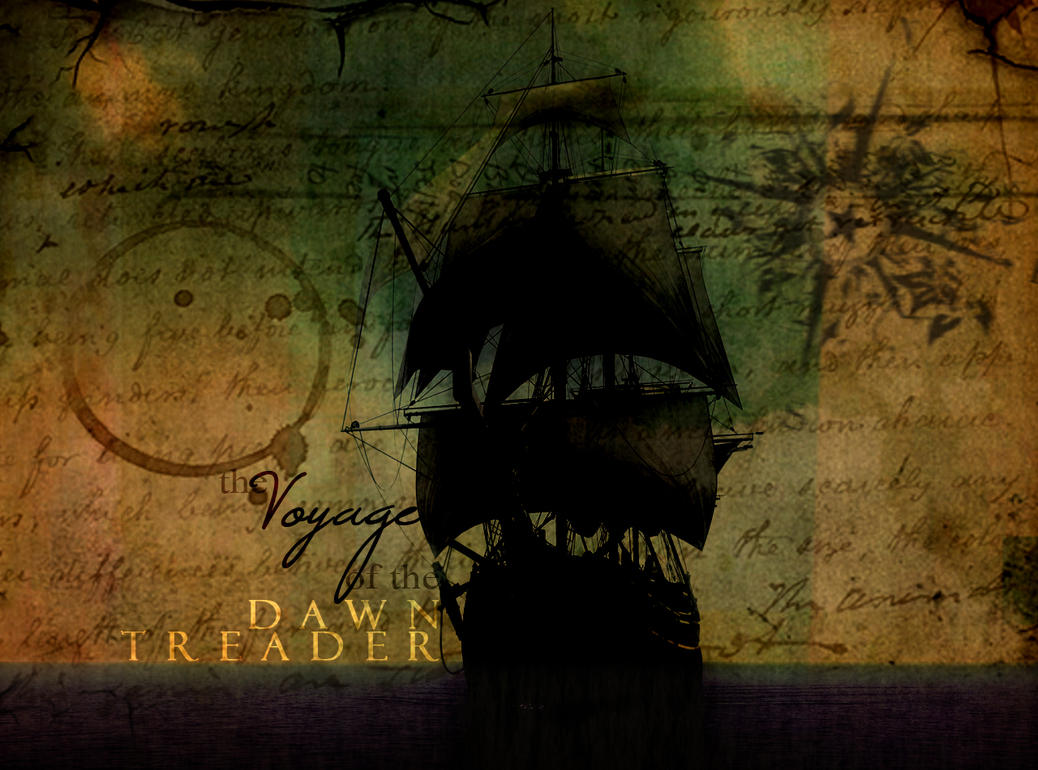
The Voyage of the Dawn Treader held its world premiere on November 30, 2010 in London at the Royal Film Performance* in Leicester Square. It was the first time the Royal Film Performance was screened in Digital 3-D and the second time a Narnia film premiered at the event, the first being The Lion, the Witch, and the Wardrobe in 2005. The premiere was attended by various personalities, including Queen Elizabeth II and Prince Philip.
*The Royal Film Performance is a charity performance of a British film which is attended by members of the British Royal Family. The proceeds from the evening's entertainment are donated to the Cinema and Television Benevolent Fund, a charity which offers financial support to people from the film, cinema and television who encounter accident, illness, bereavement or unemployment.
The tradition was started with A Matter of Life and Death in 1946 and has continued every year since then.
The Royal World Premiere of The Chronicles of Narnia: The Voyage of the Dawn Treader held at The Odeon Leicester Square on November 30, 2010 in London, United Kingdom
Set a year after the events of the previous film, the two youngest Pevensies Edmund (Skandar Keynes) and Lucy (Georgie Henley) are transported back to Narnia along with their cousin Eustace Scrubb (Will Poulter). They join the new king of Narnia, Caspian (Ben Barnes) in his quest to rescue seven lost lords to save Narnia from a corrupting evil that resides on a dark island. Each character is tested as they journey to the home of the great lion Aslan at the far end of the world.
The film premiered on November 30, 2010, at a Royal Film Performance in London. It had a wide theatrical release in traditional 2D, RealD 3D, and Digital 3D, and a limited release in 4D worldwide on December 10.
Award nominations
On 14 December 2010, the song "There's a Place for Us" from the film was nominated for a Golden Globe Award for Best Original Song at the 68th Golden Globe Awards. It also received 3 nominations in Best Youth Actor (Will Poulter), Best Live Action Family Film and Best Original Song at Phoenix Film Critics Society Awards.
Plot Begun in January, completed in February 1950 and published on 15 September 1952, The Voyage of the ‘Dawn Treader’ returns Edmund and Lucy Pevensie, along with their priggish cousin, Eustace Scrubb, to Narnia. Once there, they join Caspian's voyage on the ship Dawn Treader to find the seven lords who were banished when Miraz took over the throne. This perilous journey brings them face to face with many wonders and dangers as they sail toward Aslan's country at the end of the world.
Influences
Arguably, Voyage of the Dawn Treader is the novel which shows the most influence from Lewis' Irish background. It is reminiscent of the Immram genre of Irish literature. However, unlike such voyages, The Dawn Treader travels East, rather than West.
It was suggested that that the Odyssey was an inspiration for it as well. It might also symbolize Paul's journey in the Bible.
The Chronicles of Narnia: Prince Caspian,
illustrated by Pauline Baynes
Image via books online store
Prince Caspian: The Return to Narnia is a novel for children by C. S. Lewis, written in late 1949 and first published in 1951. It is the second book in the Chronicles of Narnia series, although in the overall chronological sequence it comes fourth.
Themes
The two major themes of the story are courage and chivalry and, as Lewis himself said in a letter to an American girl, "the restoration of the true religion after a corruption".
Adaptations
The BBC adapted Prince Caspian in two episodes of the 1989 series of The Chronicles of Narnia.
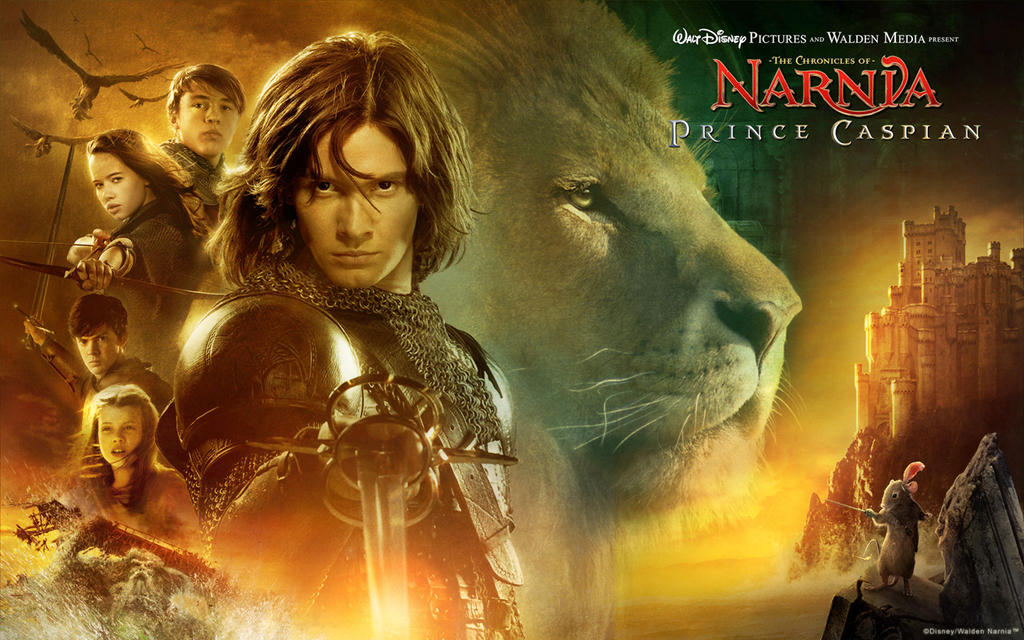
The second in the series of films from Walden Media, titled The Chronicles of Narnia: Prince Caspian, was released in the US on 16 May 2008. The UK release date was 26 June 2008.
The Chronicles of Narnia: The Lion, the Witch and the Wardrobe is a 2005 epic fantasy adventure film directed by Andrew Adamson and based on The Lion, the Witch and the Wardrobe, the first published and second chronological novel in C. S. Lewis's children's epic fantasy series, The Chronicles of Narnia. It was co-produced by Walden Media and Walt Disney Pictures and distributed by Walt Disney Pictures. William Moseley, Anna Popplewell, Georgie Henley and Skandar Keynes play Peter, Susan, Lucy and Edmund, four British children evacuated during the Blitz to the countryside, who find a wardrobe that leads to the fantasy world of Narnia. There they ally with the Lion Aslan (voiced by Liam Neeson) against the forces of Jadis, the White Witch (Tilda Swinton).
The film was released on December 9, 2005 in both Europe and North America to positive reviews and was highly successful at the box office. It won the 2005 Academy Award for Best Make Up and various other awards and is the first film in the series of films based on the books. An Extended Edition was released on December 12, 2006 and was only made available on DVD until January 31, 2007 when it was discontinued. It was the best selling DVD in North America in 2006 taking in $332.7 million that year. Source: wiki
The Lion, the Witch and the Wardrobe cover. Image: photobucket
The Lion, the Witch and the Wardrobe is a fantasy novel for children by C. S. Lewis. Published in 1950 and set circa 1940, it is the first-published book of The Chronicles of Narnia and is the best known book of the series. Although it was written and published first, it is second in the series' internal chronological order, after The Magician's Nephew. Time magazine included the novel in its TIME 100 Best English-language Novels from 1923 to 2005. It has also been published in 47 foreign languages.
Lewis dedicated the book to his god-daughter, Lucy Barfield.
Writing
Lewis described the origin of The Lion, the Witch and the Wardrobe in an essay entitled It All Began with a Picture:
"The Lion all began with a picture of a Faun carrying an umbrella and parcels in a snowy wood. This picture had been in my mind since I was about sixteen. Then one day, when I was about forty, I said to myself: 'Let's try to make a story about it.'"
The Lion, the Witch and the Wardrobe. Faun carrying an umbrella and parcels. Image: photobucket
Shortly before World War II, many children were evacuated from London to the English countryside to escape attacks on London by Nazi Germany. On 2 September 1939 three school girls: Margaret, Mary and Katherine, came to live at The Kilns in Risinghurst, Lewis's home three miles east of Oxford city centre. Lewis later suggested that the experience gave him a new appreciation of children and in late September he began a children's story on an odd sheet which has survived as part of another manuscript:
"This book is about four children whose names were Ann, Martin, Rose and Peter. But it is most about Peter who was the youngest. They all had to go away from London suddenly because of Air Raids, and because Father, who was in the Army, had gone off to the War and Mother was doing some kind of war work. They were sent to stay with a kind of relation of Mother's who was a very old professor who lived all by himself in the country."
How much more of the story Lewis then wrote is uncertain. Roger Lancelyn Green thinks that he might even have completed it. In September 1947 C.S. Lewis wrote in a letter about stories for children: "I have tried one myself but it was, by the unanimous verdict of my friends, so bad that I destroyed it."
In August 1948, during the visit of the American writer Chad Walsh, Lewis vaguely talked about completing a children's book which he had begun "in the tradition of E. Nesbit". After this conversation not much happened - until the beginning of the next year. Then everything changed.
In his essay It All Began With a Picture C.S. Lewis continues: "At first I had very little idea how the story would go. But then suddenly Aslan came bounding into it. I think I had been having a good many dreams of lions about that time. Apart from that, I don't know where the Lion came from or why He came. But once He was there, He pulled the whole story together, and soon He pulled the six other Narnian stories in after Him."
On 10 March 1949 Roger Lancelyn Green dined with him at Magdalen College. After the meal, Lewis read two chapters from his new children's story to Green. Lewis asked Green's opinion of the tale, and Green thought it was good. The manuscript of The Lion, the Witch and the Wardrobe was complete by the end of March 1949. Lucy Barfield received it by the end of May. When on 16 October 1950 Geoffrey Bles in London published the first edition, three new Chronicles - Prince Kaspian, The Voyage of the Dawn Threader and The Horse and His Boy - had also been completed.
The Chronicles of Narnia (film series) Image by spunkynell
The Chronicles of Narnia is a series of epicfantasy films from Walden Media based on the series of novels, The Chronicles of Narnia written by C. S. Lewis in the 1950s. It currently consists of three films of a planned heptalogy - The Lion, the Witch and the Wardrobe (2005), Prince Caspian (2008), and The Voyage of the Dawn Treader (2010).
Although Lewis did not want his books to be turned into films, it has been done four times, three of them for television. The BBC made television serial adaptations of The Lion, the Witch and the Wardrobe, Prince Caspian, The Voyage of the Dawn Treader and The Silver Chair. A film version of The Lion, the Witch and the Wardrobe, entitled The Chronicles of Narnia: The Lion, the Witch and the Wardrobe, produced by Walden Media and distributed by Walt Disney Pictures was released in December 2005. Permission for films to be made was given by C. S. Lewis' stepson, Douglas Gresham. It was directed by Andrew Adamson. The screenplay was written by Ann Peacock. Principal photography for the film took place in Poland, the Czech Republic and New Zealand. Source: wiki
The Chronicles of Narnia is a series of seven fantasynovels for children written by C. S. Lewis. It is considered a classic of children's literature and is the author's best-known work, having sold over 100 million copies in 47 languages. Written by Lewis between 1949 and 1954, illustrated by Pauline Baynes and published in London between October 1950 and March 1956, The Chronicles of Narnia has been adapted several times, complete or in part, for radio, television, stage, and cinema. In addition to numerous traditional Christian themes, the series borrows characters and ideas from Greek and Roman mythology, as well as from traditional British and Irishfairytales.
The Chronicles of Narnia presents the adventures of children who play central roles in the unfolding history of the fictional realm of Narnia, a place where animals talk, magic is common, and good battles evil.
The series
Lewis originally conceived what would become Narnia in 1939. However the vast majority of the text was written by between 1949 and 1954. The books were written in neither the order they were originally published nor in the chronological order in which they are currently presented.
Lewis was awarded the 1956 Carnegie Medal for The Last Battle, the final book in the Narnia series.
The seven books that make up The Chronicles of Narnia are presented here in the order in which they were originally published:
The Lion, the Witch and the Wardrobe (1950)
Prince Caspian: The Return to Narnia (1951)
The Voyage of the Dawn Treader (1952)
The Silver Chair (1953)
The Horse and His Boy (1954)
The Magician's Nephew (1955)
The Last Battle (1956)
People don't have fortunes left them in that style nowadays; men have to work and women to marry for money. It's a dreadfully unjust world.
Louisa May Alcott (1832-1888)