Astronauts on the International Space Station dissolved an effervescent tablet in a floating ball of water, and captured images using a camera capable of recording four times the resolution of normal high-definition cameras. The higher resolution images and higher frame rate videos can reveal more information when used on science investigations, giving researchers a valuable new tool aboard the space station. This footage is one of the first of its kind. The cameras are being evaluated for capturing science data and vehicle operations by engineers at NASA's Marshall Space Flight Center in Huntsville, Alabama.
Showing posts with label science. Show all posts
Showing posts with label science. Show all posts
Friday, July 31, 2015
Thursday, July 16, 2015
'Mordor' on Pluto
NEW: Pluto’s largest moon Charon has youthful terrain & dark area nicknamed 'Mordor' in north: http://t.co/fNUDVAOW5h pic.twitter.com/JOWaoD1sdy
— NASA (@NASA) 15 июля 2015
Friday, July 5, 2013
Visualising Electromagnetic Fields
The world around us is populated by invisible phenomenon. Most of the modern technology that we use is sometimes invisible. As interaction designers, we constantly talk about them and use them to shape experiences. However, sometimes we also wonder how might they look and behave like? And that is exactly what this project set out to explore – to make the invisible visible.
Monday, March 18, 2013
Amazing Water & Sound Experiment
brusspup:
This is a really fun project and when you first see the results, chances are your jaw will drop. The main thing to keep in mind for this project is that you need a camera that shoots 24 fps.
The effect that you are seeing can't be seen with the naked eye. The effect only works through the camera. However, there is a version of the project you can do where the effect would be visible with the naked eye. For that project, you'd have to use a strobe light.
Saturday, September 22, 2012
Ig Nobel Prize 2012
 |
| Ig Nobel Prize Ceremony. Photo credit: ptwo |
The Ig Nobel Prizes are an American parody of the Nobel Prizes and are given each year in early October for ten unusual or trivial achievements in scientific research. The stated aim of the prizes is to "first make people laugh, and then make them think". The awards are sometimes veiled criticism (or gentle satire). Organized by the scientific humor magazine Annals of Improbable Research (AIR), they are presented by a group that includes Nobel Laureates at a ceremony at Harvard University's Sanders Theater, and they are followed by a set of public lectures by the winners at MIT.
The name is a play on the words ignoble ("characterized by baseness, lowness, or meanness") and the Nobel Prize.
Saturday, August 11, 2012
Mars Curiosity's Descent and First Low-Resolution Color Panorama
The Curiosity Mars Descent Imager (MARDI) captured the rover's descent to the surface of the Red Planet. The instrument shot 4 fps video from heatshield separation to the ground.
This movie shows the first 360-degree panorama in color of the Gale crater landing site taken by NASA's Curiosity rover. It was made from thumbnail versions of images taken by the 34-millimeter Mast Camera on Aug. 8, 2012.
View more gifts at Zazzle.
Tuesday, April 12, 2011
First Orbit - See What Yuri Gagarin Saw
A real time recreation of Yuri Gagarin's pioneering first orbit, shot entirely in space from on board the International Space Station. The film combines this new footage with Gagarin's original mission audio and a new musical score by composer Philip Sheppard. For more information visit www.firstorbit.org

Yuri Gagarin: First Man in Space
On the 12th of April 1961, 50 years ago Yuri Gagarin became the first human to travel into space.

April 12 was already a huge day in space history twenty years before the launch of the first shuttle mission. On that day in 1961, Russian cosmonaut Yuri Gagarin (left, on the way to the launch pad) became the first human in space, making a 108-minute orbital flight in his Vostok 1 spacecraft. Newspapers like The Huntsville Times (right) trumpeted Gagarin's accomplishment.
via nasa
 |
Yuri Gagarin via ~Colins7 |
April 12 was already a huge day in space history twenty years before the launch of the first shuttle mission. On that day in 1961, Russian cosmonaut Yuri Gagarin (left, on the way to the launch pad) became the first human in space, making a 108-minute orbital flight in his Vostok 1 spacecraft. Newspapers like The Huntsville Times (right) trumpeted Gagarin's accomplishment.
via nasa
Tuesday, March 29, 2011
Festo's Artificial SmartBird
SmartBird is an ultralight but powerful flight model with excellent aerodynamic qualities and extreme agility. With SmartBird, Festo has succeeded in deciphering the flight of birds - one of the oldest dreams of humankind.
Monday, February 7, 2011
Planets Scale
What if other planetary bodies orbited our world at the same distance as the moon? How large would they appear on the sky?
Here's an animation Brad Goodspeed did to make you feel small.
The basic idea is, each planet you see is the size it would appear in the sky if it shared an orbit with the moon, 380,000 kms from earth. This video is created in After Effects.
Thursday, December 23, 2010
Winter Solstice Lunar Eclipse (photos and video)
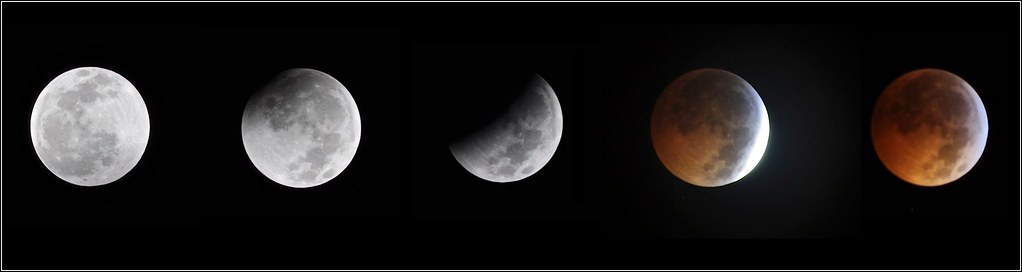 |
| Winter Solstice Lunar Eclipse. Photo by fincher69 on flickr |
The December 2010 lunar eclipse occurred from 5:27 to 11:06 UTC on December 21, coinciding with the date of the December solstice. It was visible in its entirety as a total lunar eclipse in North and South America, Iceland and northern Scandinavia.
The eclipse of December 2010 was the first total lunar eclipse in almost three years, since the February 2008 lunar eclipse.
It is the second of two lunar eclipses in 2010. The first was a partial lunar eclipse on June 26, 2010.
The eclipse was the first total lunar eclipse to occur on the day of the Northern Winter Solstice (Southern Summer Solstice) since 1638, and only the second in the Common Era.
Source: wiki
Photo gallery:

Video:
Time lapse video of Winter Solstice Lunar Eclipse on December 21, 2010 from 1:10 AM EST (6:10 GMT) to 5:03 AM EST (10:03 GMT) from Gainesville Florida. Music is Claude Debussy Nocturnes: Sirènes.
Saturday, December 11, 2010
Huge smiley face on the Sun
Scientists have discovered and photographed a giant smiley face on the Sun. The images were obtained with the help of NASA Solar Dynamics Observatory satellite.
“A smiley approximately 600,000 kilometers long and a pair of eyes 200,000 kilometers in diameter are formed by the magnetic fields of the Sun. Black areas are fields with negative polarity and the whites are those with positive polarity. The Sun’s ‘irises’ are four times bigger then the Earth – you can really drown in those eyes,” says a report from the institute’s Laboratory of X-Ray Astronomy of the Sun.
“A smiley approximately 600,000 kilometers long and a pair of eyes 200,000 kilometers in diameter are formed by the magnetic fields of the Sun. Black areas are fields with negative polarity and the whites are those with positive polarity. The Sun’s ‘irises’ are four times bigger then the Earth – you can really drown in those eyes,” says a report from the institute’s Laboratory of X-Ray Astronomy of the Sun.
 |
| Giant smiley face on the Sun. © NASA, SDO |
Monday, November 8, 2010
SunFlower: the Fibonacci sequence, Golden Section

The head of a flower is made up of small seeds which are produced at the center, and then migrate towards the outside to fill eventually all the space (as for the sunflower but on a much smaller level). Each new seed appears at a certain angle in relation to the preceeding one. For example, if the angle is 90 degrees, that is 1/4 of a turn.
Of course, this is not the most efficient way of filling space. In fact, if the angle between the appearance of each seed is a portion of a turn which corresponds to a simple fraction, 1/3, 1/4, 3/4, 2/5, 3/7, etc (that is a simple rational number), one always obtains a series of straight lines. If one wants to avoid this rectilinear pattern, it is necessary to choose a portion of the circle which is an irrational number (or a nonsimple fraction). If this latter is well approximated by a simple fraction, one obtains a series of curved lines (spiral arms) which even then do not fill out the space perfectly.
In order to optimize the filling, it is necessary to choose the most irrational number there is, that is to say, the one the least well approximated by a fraction. This number is exactly the golden mean. The corresponding angle, the golden angle, is 137.5 degrees. (It is obtained by multiplying the non-whole part of the golden mean by 360 degrees and, since one obtains an angle greater than 180 degrees, by taking its complement). With this angle, one obtains the optimal filling, that is, the same spacing between all the seeds.
This angle has to be chosen very precisely: variations of 1/10 of a degree destroy completely the optimization. When the angle is exactly the golden mean, and only this one, two families of spirals (one in each direction) are then visible: their numbers correspond to the numerator and denominator of 2 consecutive numbers in the Fibonacci sequence, which is proved to converge toward the Golden Mean value of 1.6180339... (in the picture we have 21/34, the 7th and 8th terms of the Fibonacci sequence).
These numbers are precisely those of the Fibonacci sequence (the bigger the numbers, the better the approximation) and the choice of the fraction depends on the time laps between the appearance of each of the seeds at the center of the flower.
This is why the number of spirals in the centers of sunflowers, and in the centers of flowers in general, correspond to a Fibonacci number. Moreover, generally the petals of flowers are formed at the extremity of one of the families of spiral (true, I count 34 for this sunflower). This then is also why the number of petals corresponds on average to a Fibonacci number.
[Photo, info: flickr.com/photos/lucapost Original description adapted from: www.popmath.org.uk]
Related story:

...................................................................................................................................
Nature by Numbers
A short movie inspired on numbers, geometry and nature.
Go to etereaestudios.com if you are looking for more information: the theory behind the movie (Fibonacci, Golden Ratio, Delaunay, Voronoi…), stills and screenshots showing the work in progress.
...................................................................................................................................
Thursday, November 4, 2010
Flu Attack! How A Virus Invades Your Body
When you get the flu, viruses turn your cells into tiny factories that help spread the disease. In this animation, NPR's Robert Krulwich and medical animator David Bolinsky explain how a flu virus can trick a single cell into making a million more viruses.
Saturday, October 30, 2010
Portrait of the Sun
A portrait of the sun in the wavelength of hydrogen alpha light. A fine art print of this image is available for sale. © Alan Friedman


Robot Nurse
A bit scary, isn't it?
...................................................................................................................................
Monday, October 25, 2010
Periodic Table Building Blocks for Geek Kids
 |
| Periodic Table Building Blocks Set |
Parents who think their little geniuses are too smart to play with common ABC's may rejoice at this solution. The Periodic Table Building Blocks set comes with 20 multi-sided blocks featuring all of the elements on the periodic table printed in bright colors. This set is exclusive to ThinkGeek and costs $39.99. "Great for wee geeks, chemistry geeks and science teachers. In fact, we betcha that your favorite chemistry nerd would love these, even if they're 36 years, not 36 months."
 |
| Element Bacon |
 |
| Learn while you build |
...................................................................................................................................
Thursday, October 14, 2010
GigaGalaxy Zoom - From The Eye To The Telescope

In the framework of the International Year of Astronomy 2009, ESO has launched a new project aimed at connecting the sky as seen by the unaided eye with that seen by hobby and professional astronomers.
The project, called GigaGalaxy Zoom, reveals three amazing, ultra-high-resolution images of the night sky that online stargazers can zoom in on and explore in an incredible level of detail. The reward is the most breathtaking dive ever made into our Galaxy, linking the sky seen by all with the cosmos studied by astronomers.
In this episode of ESOcast we will explore the unique and amazing GigaGalaxy Zoom project, which reveals the whole night sky as it appears with the unaided eye from one of the darkest deserts on Earth.
The project allows users to zoom in on a rich region of the Milky Way with the magnification offered by a hobby telescope and then to go one step further, using the power of a professional telescope to explore details of an iconic nebula.
Most of the photographs comprising the three GigaGalaxy Zoom images were taken from La Silla and Paranal, two of ESOs observing sites in Chile. The wonderful quality of the images is a testament to the splendour of the night sky at these ESO sites, which are the most productive astronomical observatories in the world.
---
ESOcast is produced by ESO, the European Southern Observatory. ESO, the European Southern Observatory, is the pre-eminent intergovernmental science and technology organisation in astronomy designing, constructing and operating the worlds most advanced ground-based telescopes.
• www.eso.org

Subscribe to:
Posts (Atom)


Word of the Day
Word of the Day
provided by The Free Dictionary
Article of the Day
Article of the Day
provided by The Free Dictionary
This Day in History
This Day in History
provided by The Free Dictionary
Today's Birthday
Today's Birthday
provided by The Free Dictionary
In the News
In the News
provided by The Free Dictionary
Quote of the Day
Quote of the Day
provided by The Free Library

Match Up
Match Up
provided by The Free Dictionary
