Showing posts with label наука. Show all posts

Thursday, December 23, 2010

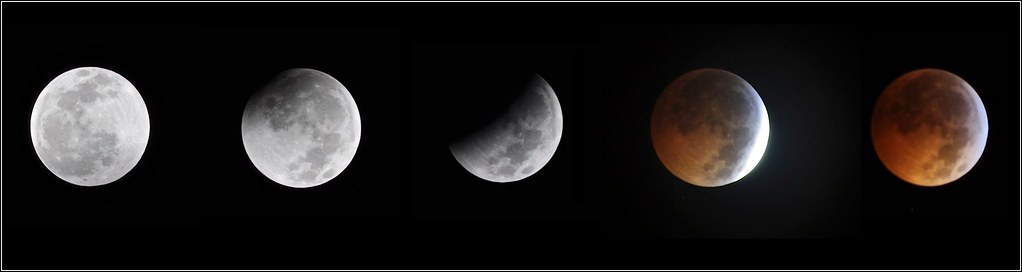
Winter Solstice Lunar Eclipse (photos and video)

Winter Solstice Lunar Eclipse. Photo by fincher69 on flickr


The December 2010 lunar eclipse occurred from 5:27 to 11:06 UTC on December 21, coinciding with the date of the December solstice. It was visible in its entirety as a total lunar eclipse in North and South America, Iceland and northern Scandinavia.

The eclipse of December 2010 was the first total lunar eclipse in almost three years, since the February 2008 lunar eclipse.
It is the second of two lunar eclipses in 2010. The first was a partial lunar eclipse on June 26, 2010.
The eclipse was the first total lunar eclipse to occur on the day of the Northern Winter Solstice (Southern Summer Solstice) since 1638, and only the second in the Common Era.
Source: wiki 

Photo gallery:


NEW YORK, NY - DECEMBER 21: A total lunar eclipse occurs as the full moon is shadowed by the Earth on December 21, 2010 in New York City. The lunar eclipse was visible during the early morning hours in North and Central America, revealing what seemed to onlookers as an eerie reddish glow on the moon. (Photo by Chris Hondros/Getty Images)

Video:

Time lapse video of Winter Solstice Lunar Eclipse on December 21, 2010 from 1:10 AM EST (6:10 GMT) to 5:03 AM EST (10:03 GMT) from Gainesville Florida.  Music is Claude Debussy Nocturnes: Sirènes.

If you would like to keep up with all latest Randomnies additions, please subscribe to Randomnies RSSRSS feed or subscribe to Randomnies by Email.

Monday, November 8, 2010

SunFlower: the Fibonacci sequence, Golden Section

The head of a flower is made up of small seeds which are produced at the center, and then migrate towards the outside to fill eventually all the space (as for the sunflower but on a much smaller level). Each new seed appears at a certain angle in relation to the preceeding one. For example, if the angle is 90 degrees, that is 1/4 of a turn.

Of course, this is not the most efficient way of filling space. In fact, if the angle between the appearance of each seed is a portion of a turn which corresponds to a simple fraction, 1/3, 1/4, 3/4, 2/5, 3/7, etc (that is a simple rational number), one always obtains a series of straight lines. If one wants to avoid this rectilinear pattern, it is necessary to choose a portion of the circle which is an irrational number (or a nonsimple fraction). If this latter is well approximated by a simple fraction, one obtains a series of curved lines (spiral arms) which even then do not fill out the space perfectly.
In order to optimize the filling, it is necessary to choose the most irrational number there is, that is to say, the one the least well approximated by a fraction. This number is exactly the golden mean. The corresponding angle, the golden angle, is 137.5 degrees. (It is obtained by multiplying the non-whole part of the golden mean by 360 degrees and, since one obtains an angle greater than 180 degrees, by taking its complement). With this angle, one obtains the optimal filling, that is, the same spacing between all the seeds.
This angle has to be chosen very precisely: variations of 1/10 of a degree destroy completely the optimization. When the angle is exactly the golden mean, and only this one, two families of spirals (one in each direction) are then visible: their numbers correspond to the numerator and denominator of 2 consecutive numbers in the Fibonacci sequence, which is proved to converge toward the Golden Mean value of 1.6180339... (in the picture we have 21/34, the 7th and 8th terms of the Fibonacci sequence).
These numbers are precisely those of the Fibonacci sequence (the bigger the numbers, the better the approximation) and the choice of the fraction depends on the time laps between the appearance of each of the seeds at the center of the flower.
This is why the number of spirals in the centers of sunflowers, and in the centers of flowers in general, correspond to a Fibonacci number. Moreover, generally the petals of flowers are formed at the extremity of one of the families of spiral (true, I count 34 for this sunflower). This then is also why the number of petals corresponds on average to a Fibonacci number.
[Photo, info: flickr.com/photos/lucapost Original description adapted from: www.popmath.org.uk]
Related story:
...................................................................................................................................
If you would like to keep up with all latest Randomnies additions, please subscribe to Randomnies RSSRSS feed or subscribe to Randomnies by Email.

Nature by Numbers


A short movie inspired on numbers, geometry and nature.
Go to etereaestudios.com if you are looking for more information: the theory behind the movie (Fibonacci, Golden Ratio, Delaunay, Voronoi…), stills and screenshots showing the work in progress.

...................................................................................................................................
If you would like to keep up with all latest Randomnies additions, please subscribe to Randomnies RSSRSS feed or subscribe to Randomnies by Email.

Thursday, November 4, 2010

Flu Attack! How A Virus Invades Your Body

When you get the flu, viruses turn your cells into tiny factories that help spread the disease. In this animation, NPR's Robert Krulwich and medical animator David Bolinsky explain how a flu virus can trick a single cell into making a million more viruses.


If you would like to keep up with all latest Randomnies additions, please subscribe to Randomnies RSSRSS feed or subscribe to Randomnies by Email.

Saturday, October 30, 2010

Robot Nurse


A bit scary, isn't it?
...................................................................................................................................
If you would like to keep up with all latest Randomnies additions, please subscribe to Randomnies RSSRSS feed or subscribe to Randomnies by Email.

Monday, October 25, 2010

Periodic Table Building Blocks for Geek Kids

Periodic Table Building Blocks Set

Parents who think their little geniuses are too smart to play with common ABC's may rejoice at this solution. The Periodic Table Building Blocks set comes with 20 multi-sided blocks featuring all of the elements on the periodic table printed in bright colors. This set is exclusive to ThinkGeek and costs $39.99. "Great for wee geeks, chemistry geeks and science teachers. In fact, we betcha that your favorite chemistry nerd would love these, even if they're 36 years, not 36 months."

Element Bacon

Learn while you build

...................................................................................................................................
If you would like to keep up with all latest Randomnies additions, please subscribe to Randomnies RSSRSS feed or subscribe to Randomnies by Email.

Thursday, October 14, 2010

GigaGalaxy Zoom - From The Eye To The Telescope


In the framework of the International Year of Astronomy 2009, ESO has launched a new project aimed at connecting the sky as seen by the unaided eye with that seen by hobby and professional astronomers.

The project, called GigaGalaxy Zoom, reveals three amazing, ultra-high-resolution images of the night sky that online stargazers can zoom in on and explore in an incredible level of detail. The reward is the most breathtaking dive ever made into our Galaxy, linking the sky seen by all with the cosmos studied by astronomers.

In this episode of ESOcast we will explore the unique and amazing GigaGalaxy Zoom project, which reveals the whole night sky as it appears with the unaided eye from one of the darkest deserts on Earth.

The project allows users to zoom in on a rich region of the Milky Way with the magnification offered by a hobby telescope and then to go one step further, using the power of a professional telescope to explore details of an iconic nebula.

Most of the photographs comprising the three GigaGalaxy Zoom images were taken from La Silla and Paranal, two of ESOs observing sites in Chile. The wonderful quality of the images is a testament to the splendour of the night sky at these ESO sites, which are the most productive astronomical observatories in the world.

---

ESOcast is produced by ESO, the European Southern Observatory. ESO, the European Southern Observatory, is the pre-eminent intergovernmental science and technology organisation in astronomy designing, constructing and operating the worlds most advanced ground-based telescopes.

www.eso.org

If you would like to keep up with all latest Randomnies additions, please subscribe to Randomnies RSSRSS feed or subscribe to Randomnies by Email.

Tuesday, October 5, 2010

Nobel Prize for Physics won by Graphene Researchers Konstantin Novoselov and Andre Geim

Konstantin Novoselov (left) and Andre Geim Photo: PA


Two University of Manchester scientists, Andre Geim and Konstantin Novoselov, have won the Nobel Prize for Physics in recognition of their "groundbreaking experiments" with graphene, a two dimensional material.

The Royal Swedish Academy of Sciences regognised Novoselov, who has joint British and Russian citizenship, and Dutch national Geim, for their work which could revolutionise the field of electronics.
Experiments with graphene, which is just one carbon atom thick, could lead to the development of new material and "the manufacture of innovative electronics," the citation said.
"Since it is practically transparent and a good conductor, graphene is suitable for producing transparent touch screens, light panels and maybe even solar cells," the academy said.
Geim, 51, and Novoselov, 36, were both born in Russia and started their careers in physics there.
The pair extracted the super-thin material from a piece of graphite such as that found in ordinary pencils, using adhesive tape to obtain a flake that was only one atom thick.
"Playfulness is one of their hallmarks, one always learns something in the process and, who knows, you may even hit the jackpot," the Nobel committee said.
The academy said that graphene offered physicists the ability to study two-dimensional materials with unique properties and made possible experiments that can give new twists to the phenomena in quantum physics.
"Also a vast variety of practical applications now appear possible including the creation of new materials and the manufacture of innovative electronics," it said.
Mentioning a few possible applications, the academy said graphene transistors were expected to become much faster than today's silicon ones and yield more efficient computers.
The prize of 10 million Swedish crowns ($1.5 million), awarded by the Nobel Committee for Physics at the Royal Swedish Academy of Sciences, was the second of this year's Nobel prizes.
If you would like to keep up with all latest Randomnies additions, please subscribe to Randomnies RSSRSS feed or subscribe to Randomnies by Email.

Thursday, August 19, 2010

Rubens' Tube


The Rubens' tube, also known as the Standing wave flame tube, or simply flame tube, is a physics experiment demonstrating a standing wave. It shows the relationship between sound waves and sound pressure.

Overview

A length of pipe is perforated along the top and sealed at both ends - one seal is attached to a small speaker or frequency generator, the other to a supply of a flammable gas (propane tank). The pipe is filled with the gas, and the gas leaking from the perforations is lit. If a suitable constant frequency is used, a standing wave can form within the tube. When the speaker is turned on, the standing wave will create points with oscillating (higher and lower) pressure and points with constant pressure (pressure nodes) along the tube. Where there is oscillating pressure due to the sound waves, less gas will escape from the perforations in the tube, and the flames will be lower at those points. At the pressure nodes, the flames are higher. At the end of the tube gas molecule velocity is zero and oscillating pressure is maximal, thus low flames are observed. It is possible to determine the wavelength from the flame minima and maxima by simply measuring with a ruler.

Explanation

Since the time averaged pressure is equal at all points of the tube, it is not straightforward to explain the different flame heights. The flame height is proportional to the gas flow as shown in the figure. Based on Bernoulli's principle, the gas flow is proportional to the square root of the pressure difference between the inside and outside of the tube. This is shown in the figure for a tube without standing sound wave. Based on this argument, the flame height depends non-linearly on the local, time-dependent pressure. The time average of the flow is reduced at the points with oscillating pressure and thus flames are lower.
Source


The classic physics experiment involving sound, a tube of propane and fire.
If you would like to keep up with all latest Randomnies additions, please subscribe to Randomnies RSSRSS feed or subscribe to Randomnies by Email.

Saturday, June 19, 2010

Gulf Oil Spill: Where it's been, Where it's going


Using satellites, scientists have been tracking the movement of BP's Deep Water Horizon oil slick as currents have pushed it closer and closer to the Gulf Coast. Now, scientists at the National Center for Atmospheric Research have used supercomputers to simulate its path in coming months as it moves up the Atlantic seaboard in major ocean currents.
If you would like to keep up with all latest Randomnies additions, please subscribe to Randomnies RSSRSS feed or subscribe to Randomnies by Email.

Subscribe

Related Posts Plugin for WordPress, Blogger...
Word of the Day

Article of the Day

This Day in History

Today's Birthday

In the News

Quote of the Day

Spelling Bee
difficulty level:
score: -
please wait...
 
spell the word:

Match Up
Match each word in the left column with its synonym on the right. When finished, click Answer to see the results. Good luck!

 
Add to The Free Dictionary