The Chronicles of Narnia: The Lion, the Witch and the Wardrobe is a 2005 epic fantasy adventure film directed by Andrew Adamson and based on The Lion, the Witch and the Wardrobe, the first published and second chronological novel in C. S. Lewis's children's epic fantasy series, The Chronicles of Narnia. It was co-produced by Walden Media and Walt Disney Pictures and distributed by Walt Disney Pictures. William Moseley, Anna Popplewell, Georgie Henley and Skandar Keynes play Peter, Susan, Lucy and Edmund, four British children evacuated during the Blitz to the countryside, who find a wardrobe that leads to the fantasy world of Narnia. There they ally with the Lion Aslan (voiced by Liam Neeson) against the forces of Jadis, the White Witch (Tilda Swinton).
The film was released on December 9, 2005 in both Europe and North America to positive reviews and was highly successful at the box office. It won the 2005 Academy Award for Best Make Up and various other awards and is the first film in the series of films based on the books. An Extended Edition was released on December 12, 2006 and was only made available on DVD until January 31, 2007 when it was discontinued. It was the best selling DVD in North America in 2006 taking in $332.7 million that year. Source: wiki
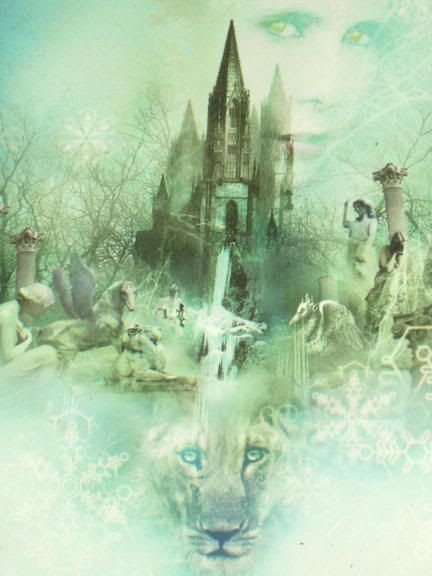
The Lion, the Witch and the Wardrobe cover. Image: photobucket
The Lion, the Witch and the Wardrobe is a fantasy novel for children by C. S. Lewis. Published in 1950 and set circa 1940, it is the first-published book of The Chronicles of Narnia and is the best known book of the series. Although it was written and published first, it is second in the series' internal chronological order, after The Magician's Nephew. Time magazine included the novel in its TIME 100 Best English-language Novels from 1923 to 2005. It has also been published in 47 foreign languages.
Lewis dedicated the book to his god-daughter, Lucy Barfield.
Writing
Lewis described the origin of The Lion, the Witch and the Wardrobe in an essay entitled It All Began with a Picture:
"The Lion all began with a picture of a Faun carrying an umbrella and parcels in a snowy wood. This picture had been in my mind since I was about sixteen. Then one day, when I was about forty, I said to myself: 'Let's try to make a story about it.'"
The Lion, the Witch and the Wardrobe. Faun carrying an umbrella and parcels. Image: photobucket
Shortly before World War II, many children were evacuated from London to the English countryside to escape attacks on London by Nazi Germany. On 2 September 1939 three school girls: Margaret, Mary and Katherine, came to live at The Kilns in Risinghurst, Lewis's home three miles east of Oxford city centre. Lewis later suggested that the experience gave him a new appreciation of children and in late September he began a children's story on an odd sheet which has survived as part of another manuscript:
"This book is about four children whose names were Ann, Martin, Rose and Peter. But it is most about Peter who was the youngest. They all had to go away from London suddenly because of Air Raids, and because Father, who was in the Army, had gone off to the War and Mother was doing some kind of war work. They were sent to stay with a kind of relation of Mother's who was a very old professor who lived all by himself in the country."
How much more of the story Lewis then wrote is uncertain. Roger Lancelyn Green thinks that he might even have completed it. In September 1947 C.S. Lewis wrote in a letter about stories for children: "I have tried one myself but it was, by the unanimous verdict of my friends, so bad that I destroyed it."
In August 1948, during the visit of the American writer Chad Walsh, Lewis vaguely talked about completing a children's book which he had begun "in the tradition of E. Nesbit". After this conversation not much happened - until the beginning of the next year. Then everything changed.
In his essay It All Began With a Picture C.S. Lewis continues: "At first I had very little idea how the story would go. But then suddenly Aslan came bounding into it. I think I had been having a good many dreams of lions about that time. Apart from that, I don't know where the Lion came from or why He came. But once He was there, He pulled the whole story together, and soon He pulled the six other Narnian stories in after Him."
On 10 March 1949 Roger Lancelyn Green dined with him at Magdalen College. After the meal, Lewis read two chapters from his new children's story to Green. Lewis asked Green's opinion of the tale, and Green thought it was good. The manuscript of The Lion, the Witch and the Wardrobe was complete by the end of March 1949. Lucy Barfield received it by the end of May. When on 16 October 1950 Geoffrey Bles in London published the first edition, three new Chronicles - Prince Kaspian, The Voyage of the Dawn Threader and The Horse and His Boy - had also been completed.
The Chronicles of Narnia is a series of seven fantasynovels for children written by C. S. Lewis. It is considered a classic of children's literature and is the author's best-known work, having sold over 100 million copies in 47 languages. Written by Lewis between 1949 and 1954, illustrated by Pauline Baynes and published in London between October 1950 and March 1956, The Chronicles of Narnia has been adapted several times, complete or in part, for radio, television, stage, and cinema. In addition to numerous traditional Christian themes, the series borrows characters and ideas from Greek and Roman mythology, as well as from traditional British and Irishfairytales.
The Chronicles of Narnia presents the adventures of children who play central roles in the unfolding history of the fictional realm of Narnia, a place where animals talk, magic is common, and good battles evil.
The series
Lewis originally conceived what would become Narnia in 1939. However the vast majority of the text was written by between 1949 and 1954. The books were written in neither the order they were originally published nor in the chronological order in which they are currently presented.
Lewis was awarded the 1956 Carnegie Medal for The Last Battle, the final book in the Narnia series.
The seven books that make up The Chronicles of Narnia are presented here in the order in which they were originally published:
The Lion, the Witch and the Wardrobe (1950)
Prince Caspian: The Return to Narnia (1951)
The Voyage of the Dawn Treader (1952)
The Silver Chair (1953)
The Horse and His Boy (1954)
The Magician's Nephew (1955)
The Last Battle (1956)
People don't have fortunes left them in that style nowadays; men have to work and women to marry for money. It's a dreadfully unjust world.
Louisa May Alcott (1832-1888)
 Image via Wikipedia